People working in the plastics industry deal with calcium carbonate almost every day.
However, when people outside the industry hear that calcium carbonate is added to plastic, their first reaction is often:
“Isn’t that just stone powder used to reduce cost?”
That explanation is far too simple.
Calcium carbonate is one of the most important mineral fillers used in plastic processing. When the correct grade, particle size and surface treatment are selected, it can reduce raw-material cost while improving rigidity, dimensional stability, processing behavior and product appearance.
This article explains:
- Why calcium carbonate is added to plastics
- The differences between GCC, PCC, nano and activated calcium carbonate
- How calcium carbonate is used in PVC, PE, PP, engineering plastics, PLA and PBAT
- What processors should consider when selecting a calcium carbonate grade
1. Why Is Calcium Carbonate Added to Plastics?
Calcium carbonate is not added merely to increase product weight. It can serve several important technical and commercial functions.
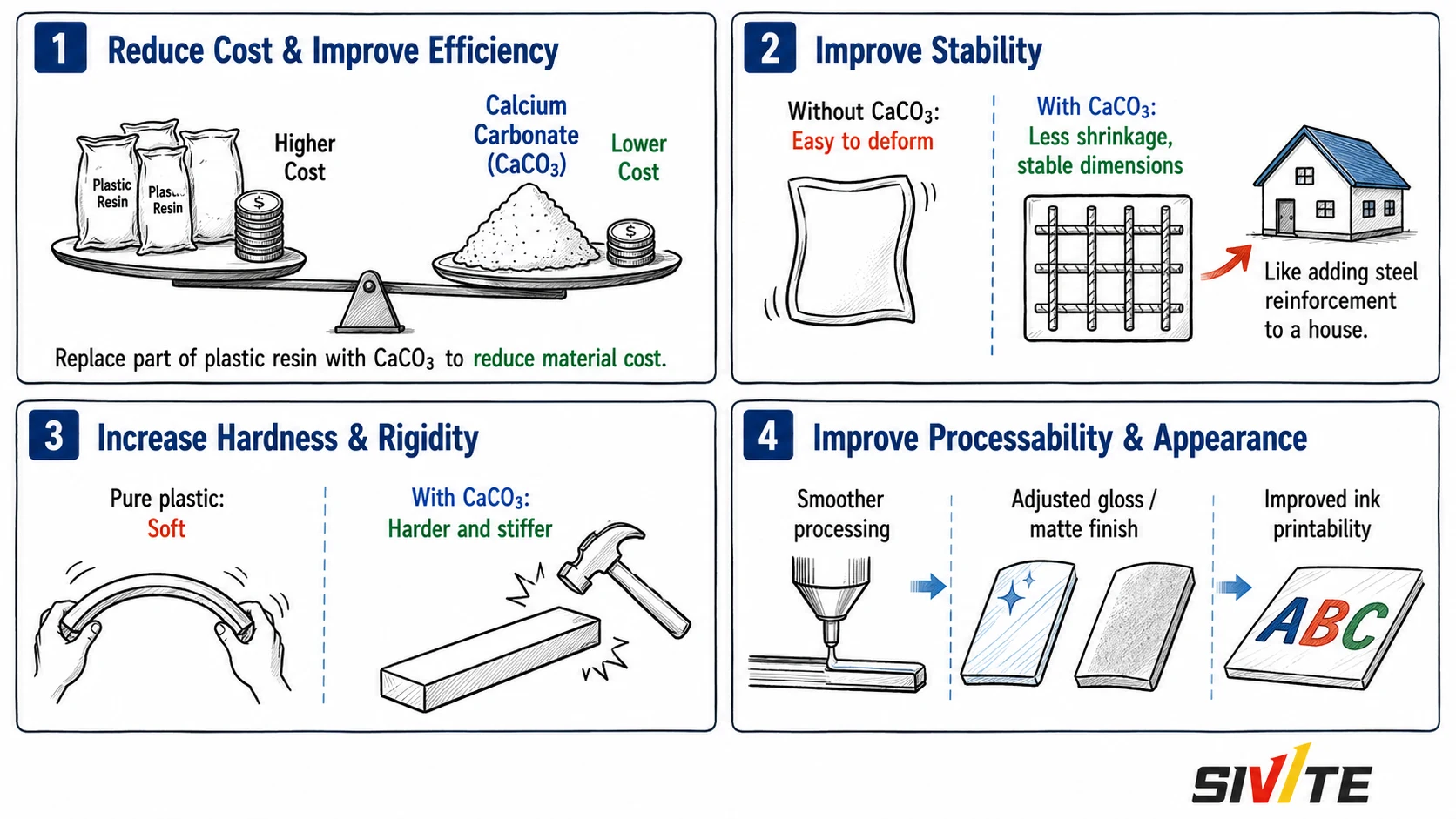
1.1 Reduce Material Cost and Improve Efficiency
Plastic resin prices can fluctuate significantly and are usually much higher than the cost of calcium carbonate.
Calcium carbonate is abundant, widely available and relatively economical. By introducing it through a properly formulated filler masterbatch, manufacturers can replace part of the polymer resin and lower the overall material cost.
The actual saving depends on:
- Resin type
- Calcium carbonate loading level
- Filler particle size
- Surface treatment
- Product performance requirements
- Dispersion quality
A higher filler loading does not automatically mean better economics. If poor dispersion causes brittleness, surface defects or unstable extrusion, the resulting scrap can eliminate the material-cost saving.
1.2 Improve Dimensional Stability
Many thermoplastics shrink during cooling.
When calcium carbonate particles are properly dispersed in the polymer matrix, they restrict polymer-chain movement and reduce overall shrinkage.
This can improve:
- Dimensional stability
- Warpage resistance
- Shape retention
- Production consistency
A simple way to understand this is to compare calcium carbonate with reinforcement inside a structure. It helps the plastic maintain its geometry during cooling and service.
This is especially useful for:
- Profiles
- Pipes
- Rigid sheets
- Injection-molded housings
- Dimensionally sensitive components
1.3 Increase Hardness and Rigidity
Pure polymer can sometimes be too soft or flexible for the intended application.
Calcium carbonate is a rigid mineral particle. When incorporated correctly, it can increase:
- Hardness
- Stiffness
- Flexural modulus
- Shape retention
However, the effect on impact strength depends heavily on the calcium carbonate grade and dispersion.
Coarse or untreated calcium carbonate may increase rigidity but reduce toughness. Fine, nano-sized or properly surface-treated grades can provide a more balanced performance.
1.4 Improve Processability and Appearance
Calcium carbonate can also modify processing behavior and surface properties.
Depending on the formulation and particle characteristics, it may help:
- Improve extrusion stability
- Adjust melt rheology
- Reduce surface gloss
- Create a matte finish
- Improve ink adhesion and printability
- Improve dimensional consistency
- Modify surface friction
- Support microporous-film formation
The final effect depends on more than just the amount of calcium carbonate. Particle size, particle shape, moisture, oil absorption and surface coating all matter.
2. The Four Main Types of Calcium Carbonate
Processors often hear terms such as heavy calcium carbonate, light calcium carbonate, nano calcium carbonate and activated calcium carbonate.
These materials are not interchangeable.
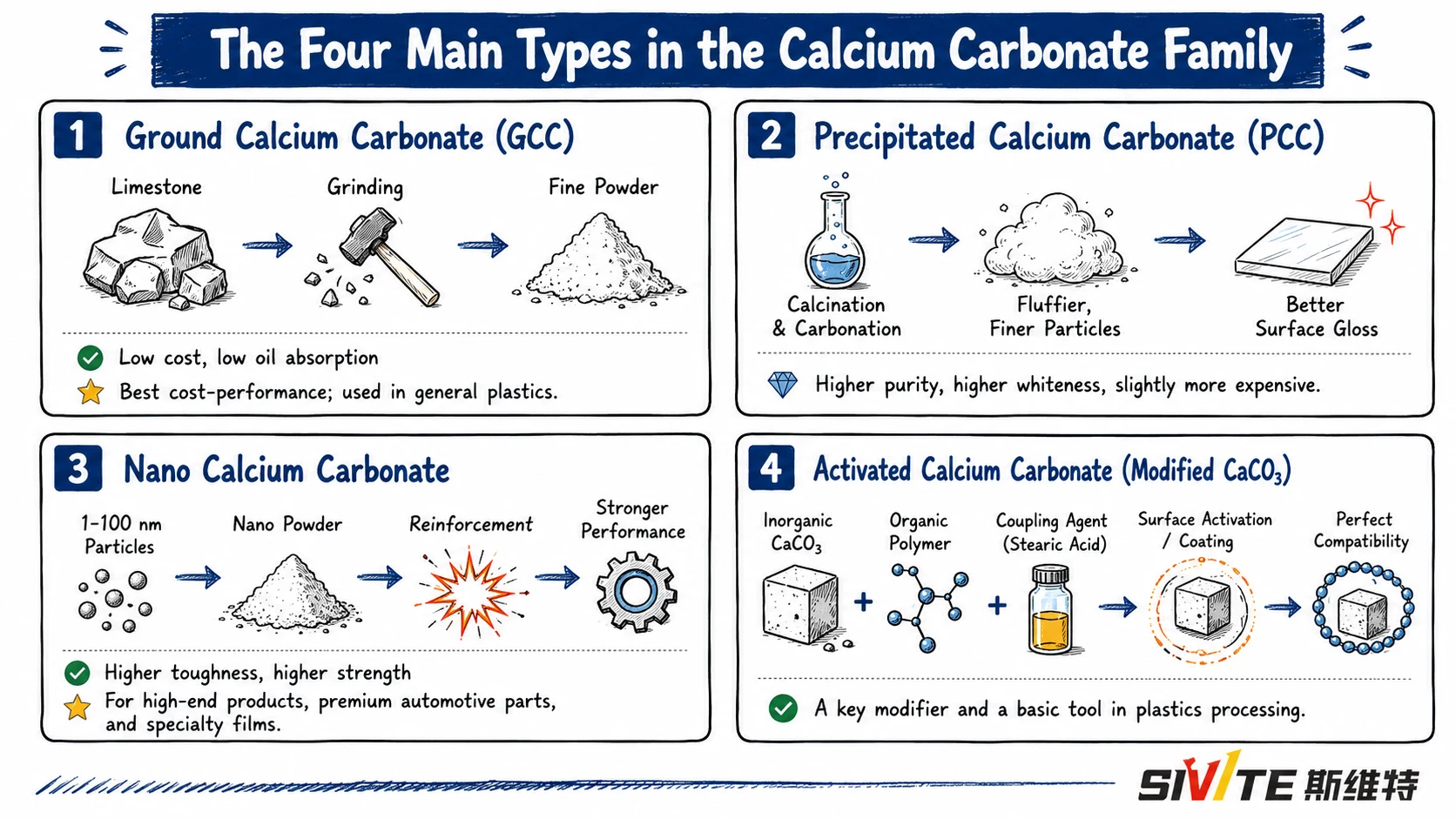
2.1 Ground Calcium Carbonate — GCC
Ground calcium carbonate is commonly known as heavy calcium carbonate.
It is produced by mechanically grinding natural minerals such as:
- Limestone
- Calcite
- Marble
Main Characteristics
- Relatively low cost
- Low oil absorption
- Widely available
- Suitable for high filler loading
- Good cost-performance ratio
GCC is widely used in general-purpose plastic products where extreme whiteness, very fine particle size or premium surface quality is not required.
Typical applications include:
- PVC pipes
- PVC profiles
- PP woven bags
- Filler masterbatch
- General extrusion products
For many ordinary plastic applications, a properly selected GCC grade provides the best balance between cost and performance.
2.2 Precipitated Calcium Carbonate — PCC
Precipitated calcium carbonate is commonly known as light calcium carbonate.
Unlike GCC, PCC is produced through a chemical process involving calcination and carbonation.
This production method allows better control of:
- Particle size
- Particle shape
- Purity
- Whiteness
Main Characteristics
- Finer particles
- Lower bulk density
- Higher purity
- Higher whiteness
- Better potential surface finish
- Usually more expensive than GCC
PCC is often selected when the processor requires:
- Smoother surfaces
- Better appearance
- More controlled particle morphology
- Higher-quality flexible PVC products
- Improved print or coating behavior
2.3 Nano Calcium Carbonate
Nano calcium carbonate typically refers to particles in the nanometer range, although the effective particle size in a compound also depends on agglomeration and dispersion.
At this scale, calcium carbonate can act as more than a simple filler.
If it is well dispersed, it may help improve:
- Toughness
- Rigidity
- Strength
- Heat resistance
- Nucleation behavior
- Dimensional stability
Typical applications include:
- Automotive plastic parts
- High-performance compounds
- Specialty films
- Engineering-plastic modification
- PLA modification
- High-quality extrusion products
Nano calcium carbonate requires excellent dispersion. If the particles remain agglomerated, the expected reinforcing effect may not be achieved.
2.4 Activated Calcium Carbonate
Calcium carbonate is an inorganic material, while most polymers are organic.
Without proper compatibility, untreated calcium carbonate may:
- Agglomerate
- Disperse poorly
- Absorb moisture
- Reduce mechanical performance
- Cause unstable processing
Activated calcium carbonate is surface-treated with agents such as:
- Stearic acid
- Titanate coupling agents
- Silane coupling agents
- Other proprietary surface modifiers
The surface treatment improves compatibility between the mineral particles and the polymer matrix.
Benefits may include:
- Better dispersion
- Lower moisture sensitivity
- Improved processing
- Better filler loading
- Reduced agglomeration
- Improved mechanical-property balance
In modern plastic processing, surface-treated calcium carbonate is widely used, especially in filler masterbatch and film applications.
3. How Calcium Carbonate Is Used in Different Plastics
Different polymers have different processing behavior and performance requirements.
Therefore, the appropriate calcium carbonate grade for PVC may not be suitable for PE film, PP automotive parts or biodegradable polymers.
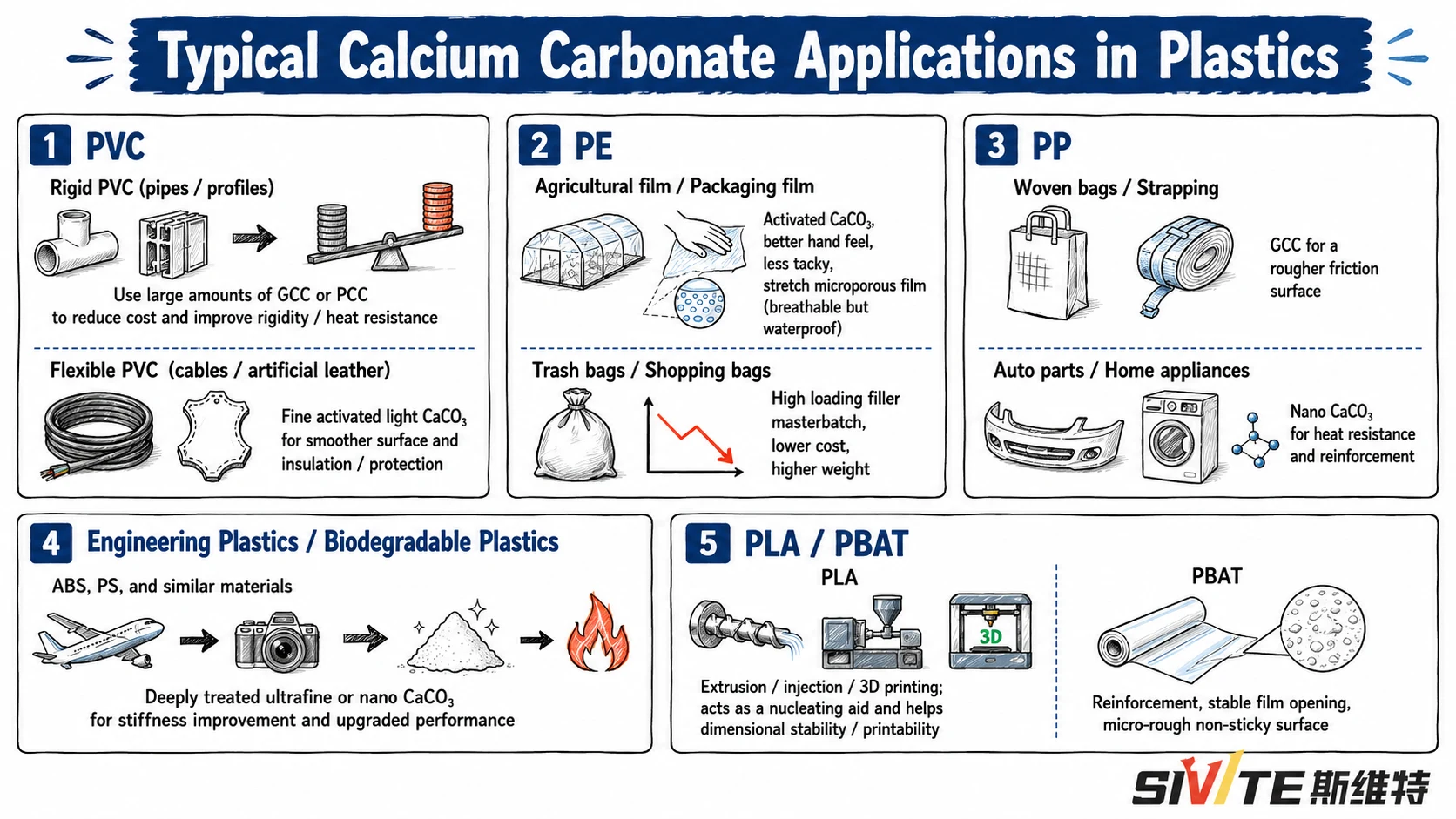
3.1 PVC
PVC is one of the largest users of calcium carbonate.
Rigid PVC: Pipes and Profiles
Rigid PVC products such as drainage pipes, conduit and window profiles often use relatively high loadings of GCC or PCC.
Main purposes include:
- Reducing formulation cost
- Increasing rigidity
- Improving dimensional stability
- Supporting heat resistance
- Improving processing consistency
The exact grade depends on the surface requirements and mechanical-performance target.
Coarser GCC may be suitable for cost-sensitive products, while finer or treated grades are preferred for better surface quality and more demanding profiles.
Flexible PVC: Cables and Artificial Leather
Flexible PVC products generally require finer, surface-treated calcium carbonate.
Typical applications include:
- Wire and cable compounds
- Artificial leather
- Flexible hoses
- Soft profiles
Fine activated PCC or treated GCC can help provide:
- Smoother surfaces
- Better dispersion
- Stable electrical insulation
- Improved processing
- Better surface appearance
3.2 PE
Calcium carbonate is widely used in polyethylene film and bag applications.
Agricultural Film and Packaging Film
In selected film formulations, activated calcium carbonate may improve:
- Surface feel
- Anti-blocking behavior
- Film stiffness
- Processing stability
In breathable film, calcium carbonate particles serve a special function.
After stretching, microscopic voids form around the mineral particles. This creates a microporous structure that can allow water vapor to pass while resisting liquid water.
This principle is widely used in breathable hygiene-film applications.
The particle-size distribution, surface treatment and stretching process must be tightly controlled. Poor dispersion can cause film breakage or inconsistent permeability.
Trash Bags and Shopping Bags
High-loading calcium carbonate filler masterbatch is frequently used in trash bags and shopping bags to lower material cost.
However, excessive filler loading may cause:
- Higher product density
- Reduced tensile strength
- Lower tear resistance
- Increased brittleness
- Unstable bubble formation
The correct loading must be determined according to the bag thickness and mechanical requirements.
3.3 PP
Woven Bags and Packing Straps
GCC is frequently used in PP woven bags and straps.
It may help:
- Adjust surface friction
- Increase stiffness
- Improve handling
- Reduce raw-material cost
For woven products, particle size and dispersion must be controlled to prevent excessive filament breakage.
Automotive Parts and Home Appliances
Modified PP compounds used in automotive parts and home appliances may use:
- Fine calcium carbonate
- Nano calcium carbonate
- Talc
- Hybrid mineral systems
The goal is not simply cost reduction. These fillers may be used to improve:
- Rigidity
- Heat resistance
- Dimensional stability
- Surface quality
- Impact-performance balance
For automotive parts, the formulation must balance stiffness and impact resistance carefully.
3.4 ABS, PS and Other Engineering Plastics
Engineering plastics are generally more expensive and often have stricter requirements for:
- Appearance
- Mechanical properties
- Thermal performance
- Dimensional precision
Calcium carbonate may still be used, but typically at lower loading levels and with more demanding specifications.
Preferred grades may include:
- Ultrafine calcium carbonate
- Nano calcium carbonate
- Deeply surface-treated calcium carbonate
Possible objectives include:
- Increasing rigidity
- Improving dimensional stability
- Supporting selected flame-retardant formulations
- Modifying surface appearance
- Reducing cost without severely reducing performance
In these applications, dispersion and interfacial compatibility are more important than simply increasing filler loading.
3.5 PLA
PLA has several well-known processing challenges:
- Brittleness
- Slow crystallization
- Limited heat resistance
- Narrow processing window
Extrusion and Injection Molding
Finely coated nano calcium carbonate can act as a heterogeneous nucleating agent.
When it is uniformly dispersed, it may help polymer chains organize and crystallize more rapidly.
Potential benefits include:
- Faster crystallization
- Improved mold-release performance
- Higher heat resistance
- Improved stiffness
- A better toughness-rigidity balance
However, poor dispersion or excessive loading can make PLA more opaque and brittle.
PLA 3D-Printing Filament
For translucent or light-transmitting PLA filament, conventional mineral powder can cause:
- Whitening
- Light scattering
- Loss of transparency
- Poor surface consistency
Special nano-grade particles with suitable optical characteristics are required.
The formulation must balance:
- Transparency
- Toughness
- Extrusion stability
- Filament dimensional consistency
- Printability
Strong but controlled screw mixing is necessary to obtain good dispersion without causing PLA degradation.
3.6 PBAT
PBAT is flexible and tough but may have:
- Low melt strength
- Strong film-to-film adhesion
- Unstable bubble behavior during blown-film processing
Melt-Strength Improvement
During upward blown-film production, pure PBAT film bubbles may shake or collapse because the melt lacks sufficient stiffness.
Calcium carbonate can restrict polymer-chain movement and increase melt rigidity.
This may help achieve:
- A more stable film bubble
- Reduced bubble vibration
- Improved processing continuity
- Better dimensional control
Anti-Blocking and Easy Bag Opening
Mineral particles create microscopic surface roughness.
This reduces the effective contact area between film layers and helps prevent blocking during winding and storage.
Calcium carbonate is therefore frequently used to improve:
- Bag opening
- Film separation
- Surface friction
- Winding performance
Particle size, surface treatment and loading level must be controlled to avoid excessive roughness or loss of mechanical strength.
4. How to Select the Right Calcium Carbonate Grade
Selecting calcium carbonate should not be based only on mesh size or price.
A practical selection process should consider:
Polymer Compatibility
Ask whether the calcium carbonate is intended for:
- PVC
- PE
- PP
- ABS
- PS
- PLA
- PBAT
- Another polymer system
Different resins need different surface treatments.
Particle Size and Distribution
Finer particles may provide better surface quality and reinforcement, but they are harder to disperse and may require stronger surface treatment.
A narrow particle-size distribution generally provides more consistent processing.
Surface Treatment
For film, masterbatch and high-loading applications, activated calcium carbonate is usually preferable because it disperses more easily in the polymer.
Moisture Content
Excessive moisture can cause:
- Bubbles
- Poor extrusion
- Surface defects
- Polymer degradation
- Unstable film bubbles
Moisture control is especially important for PLA and other hydrolysis-sensitive materials.
Oil Absorption
Higher oil absorption can increase additive and plasticizer demand.
This is particularly important in flexible PVC formulations.
Whiteness and Purity
High-whiteness products require calcium carbonate with good color consistency and low impurity levels.
Dispersion Performance
Even a premium nano calcium carbonate will not work properly if it remains agglomerated.
The compounder must match:
- Screw design
- Mixing intensity
- Feeding method
- Temperature profile
- Residence time
to the selected filler.
5. Common Mistakes When Using Calcium Carbonate
Using More Filler Only to Reduce Cost
Very high loading may reduce resin cost but can increase:
- Scrap
- Brittleness
- Equipment wear
- Motor load
- Surface defects
The lowest-cost formulation is not always the lowest-cost product.
Ignoring Surface Treatment
Untreated calcium carbonate may be difficult to disperse in non-polar polymers such as PE and PP.
Selecting Only by Mesh Number
Mesh number alone does not describe:
- Actual particle distribution
- Agglomeration
- Particle shape
- Surface coating
- Moisture
- Oil absorption
Ignoring Equipment Capability
A formula that performs well on one extruder may fail on another because of differences in:
- Screw configuration
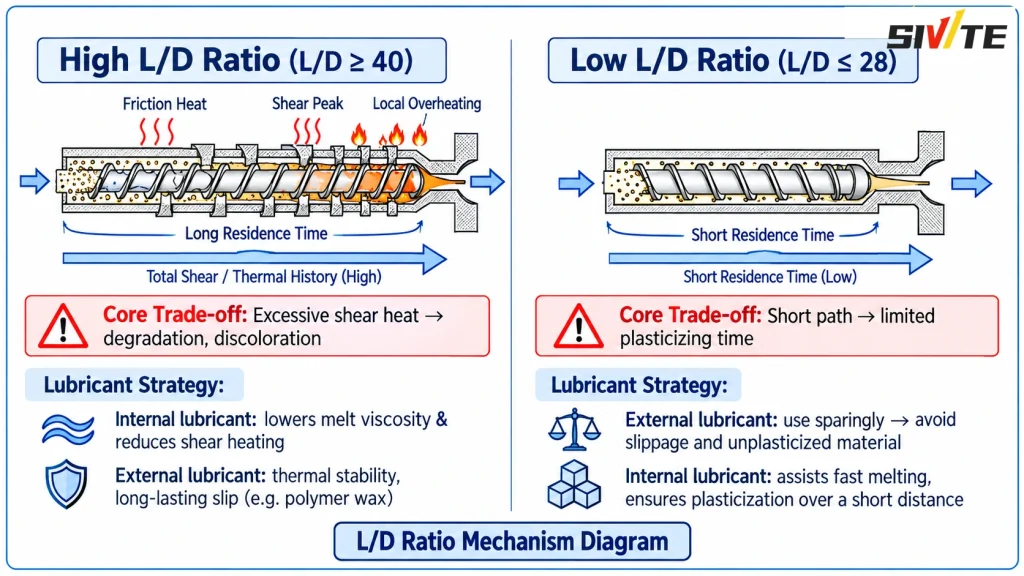
- L/D ratio
- Mixing elements
- Feeding system
- Venting
- Melt filtration
Conclusion
Calcium carbonate has long been more than a low-cost filler in the plastics industry.
When the correct type, particle size and surface treatment are selected, it can help manufacturers:
- Reduce material cost
- Improve rigidity
- Control shrinkage
- Improve dimensional stability
- Modify surface properties
- Support film processing
- Improve specialized polymer performance
The key is not simply deciding whether to add calcium carbonate.
The real engineering question is:
Which calcium carbonate grade, at what loading level, with what surface treatment and under what processing conditions?
When these factors are matched correctly, calcium carbonate can produce performance that unfilled plastic alone may not achieve.
Related Equipment
Sheet Extrusion Lines
For PET, PP and PS sheet production, review the extrusion configurations and engineering options relevant to this technical topic.
View Sheet Extrusion LinesDiscuss your application on WhatsApp