Why high light transmittance does not always mean a plastic film looks clear
Have you ever received a customer complaint saying that your plastic film is not transparent enough, even though the measured light transmittance is above 90%?
This is a common misunderstanding in plastic film extrusion, sheet production, compounding, and injection molding.
Imagine the following situation. A customer complains: “The film looks cloudy. The transparency is terrible!”
In this illustrative example, a total luminous transmittance test returns 91.5%. That high value can coexist with haze or poor see-through quality because total transmittance does not describe how narrowly the transmitted light remains distributed.
But when you visit the customer's factory, you notice something interesting. When the film is placed directly against a printed sheet, the letters appear reasonably clear. However, when the film is held farther away from the printed text, the image becomes noticeably blurred.
Both the customer and the manufacturer may be correct. The problem is that three different optical properties are being confused:
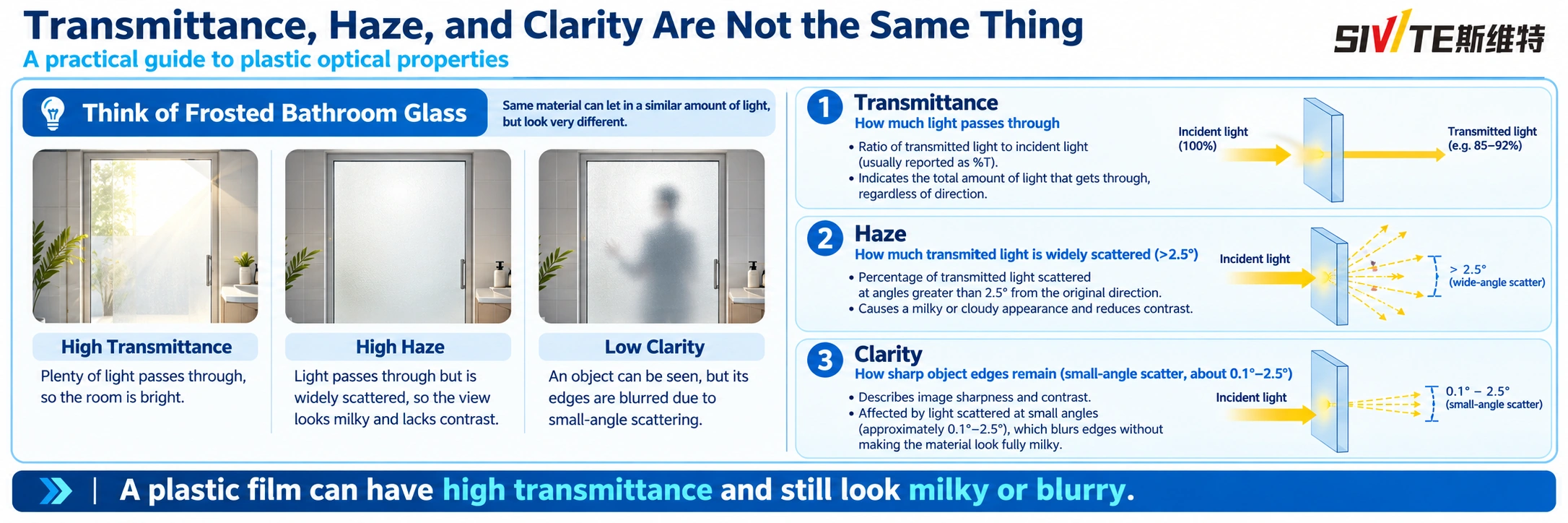
- Transmittance: How much light passes through the material?
- Haze: How much transmitted light is scattered over relatively wide angles?
- Clarity: How sharply can objects be seen through the material?
These properties are related, but they are not interchangeable. Understanding the difference is essential when developing transparent PET sheets, PP films, PS packaging sheets, optical protective films, and injection-molded transparent products.
A Simple Example: Frosted Bathroom Glass
Consider a bathroom window made from frosted glass.
On a sunny day, the bathroom may still be brightly illuminated. Plenty of daylight enters the room, indicating that the glass allows a significant amount of visible light to pass through.
However, when you look through the same glass, people and objects on the other side appear blurred or indistinct. Why? Because the glass scatters the transmitted light. It may allow substantial light transmission while producing high haze and poor image clarity.
This simple example illustrates an important principle: A material can transmit plenty of light without providing a clear view.
1. What Is Light Transmittance in Plastics?
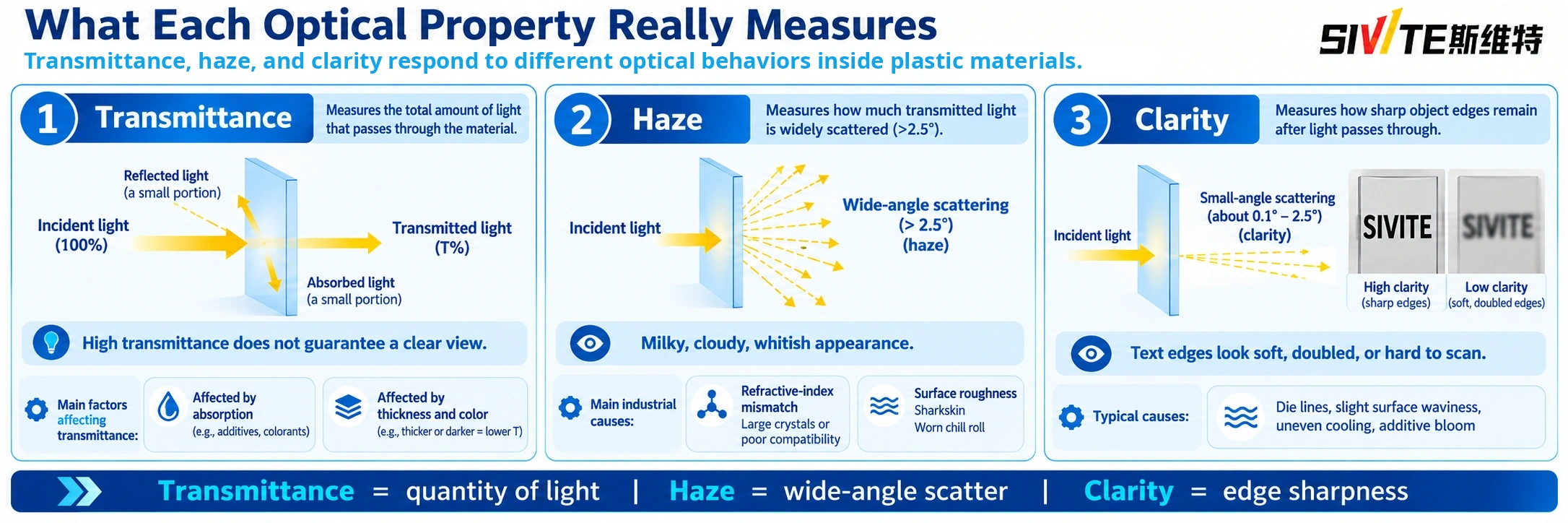
Transmittance measures how much light passes through a material
Light transmittance describes the fraction of incident light that passes through a plastic specimen.
When light reaches a plastic film or sheet, several things happen:
- Part of the light is reflected at the surfaces.
- Part of the light is absorbed by the material.
- The remaining light is transmitted through the specimen.
The transmitted light may travel directly through the material or emerge after being scattered. When measured as total luminous transmittance, both directly transmitted and diffusely transmitted light are included.
This distinction is important. A film can transmit 90% of incident visible light while scattering a substantial portion of that light. The result may be a bright-looking but cloudy film.
Why can semi-crystalline plastics still show high transmittance?
Materials such as polypropylene (PP) or polyethylene (PE) may contain crystalline structures that scatter visible light.
The degree of scattering depends on factors including:
- Crystalline morphology and structure size
- Refractive-index differences between phases
- Film thickness
- Additives and fillers
- Surface roughness
- Processing and cooling conditions
For thin films, substantial light scattering does not necessarily mean equally substantial light absorption. Therefore, measured total transmittance can remain relatively high even when the material looks hazy.
Engineering takeaway: High transmittance tells you that light is getting through. It does not prove that the transmitted image will remain sharp. For transparent films and sheets, transmittance should be evaluated together with haze and, where required, clarity.
2. What Is Haze in Plastic Film and Sheet?
Haze measures wide-angle scattering of transmitted light
Haze describes the proportion of transmitted light scattered through relatively wide angles away from the incident beam.
In the commonly used ASTM D1003 geometry, transmitted light scattered by more than 2.5° contributes to the haze value. In simplified terms, higher haze means more wide-angle scattering. This produces the familiar appearance of a cloudy, milky, or whitish plastic film. Lower haze does not automatically mean higher total luminous transmittance; the measurements describe different aspects of light transmission.
What causes high haze?
There are two major categories of causes.
A. Internal Light Scattering
Internal scattering occurs when light encounters structures with different refractive indices within the plastic.
Poor compatibility between polymer phases: In polymer blends, incompatible phases may form domains that scatter light strongly. The greater the refractive-index mismatch and the less favorable the dispersed-phase morphology, the greater the potential for haze.
Large crystalline structures: In semi-crystalline polymers, crystalline morphology can significantly affect optical properties. Large or poorly controlled structures may increase scattering.
Filler agglomeration: Inorganic fillers, poorly dispersed additives, pigments, and other particles may produce strong scattering when their size and refractive-index contrast are unfavorable.
B. Surface Light Scattering
Even when the polymer itself is optically uniform, surface defects can increase haze. Typical processing causes include:
- Worn or damaged polishing rolls
- Uneven chill-roll surfaces
- Melt fracture or sharkskin
- Poor film cooling
- Unstable blown-film conditions
- Surface contamination or deposits
These surface irregularities redirect incoming light and reduce the apparent transparency of the product.
Practical troubleshooting
If the product looks white or cloudy:
- Compare the haze of samples produced under different cooling conditions.
- Inspect the film surface for roughness, scratches, or melt fracture.
- Check polymer compatibility and dispersed-phase morphology.
- Examine filler dispersion and agglomeration.
- Evaluate crystallization behavior and suitable nucleating or clarifying additives.
For PP sheet and film applications, cooling rate and crystalline morphology are particularly important. However, faster cooling or adding a nucleating agent does not automatically reduce haze in every formulation. The final effect must be confirmed by testing.
3. What Is Clarity in Transparent Plastics?
Clarity describes image sharpness through a transparent material
Clarity is often overlooked in plastic manufacturing. Yet for many packaging and optical applications, it can be just as important as transmittance or haze.
Clarity describes how well fine details, printed characters, and object boundaries remain visible through a material. It is strongly affected by small-angle forward scattering and optical distortion.
For plastic sheeting, ASTM D1746 characterizes transparency in terms of regular transmittance and relates it to see-through clarity. Results depend strongly on the instrument beam and receptor geometry, so values from different instruments or methods should not be treated as interchangeable. Visual descriptions such as “sharp” or “blurred” are useful for diagnosis, but they are not themselves an instrument-defined clarity value.
What does poor clarity look like?
A film may appear reasonably transparent and show relatively low haze, yet produce:
- Blurred text
- Soft object edges
- Slight double images
- Reduced image sharpness
- Difficult barcode scanning
This is especially problematic in food packaging films, transparent retail packaging, PET protective films, display-related films, and transparent injection-molded parts.
Why can clarity be poor even when haze is low?
One common cause is surface irregularity. Small surface waviness can change the local direction of transmitted light, distorting the image.
Possible processing causes include:
- Uneven die flow
- Die lines or flow marks
- Unstable cooling
- Slight surface waviness
- Nonuniform surface coatings
- Additive migration or blooming
If the distortion appears as periodic cross-web bands, use the plastic sheet transverse-lines troubleshooting guide to separate roll-speed mismatch, vibration and melt-pressure instability from purely optical causes.
For example, excessive migration of slip additives may create an uneven surface layer, contributing to optical nonuniformity in some film formulations.
Internal structures can also affect clarity, so it is important not to assume that every clarity problem comes from the surface.
A useful production test
Place the film directly against printed text. Then gradually increase the distance between the film and the printed surface.
If the letters become significantly more blurred as the distance increases, small-angle scattering or optical distortion may be contributing to poor clarity.
This test is useful for quick visual screening, although it does not replace a standardized instrument measurement.
4. Four Typical Optical Conditions in Plastic Products
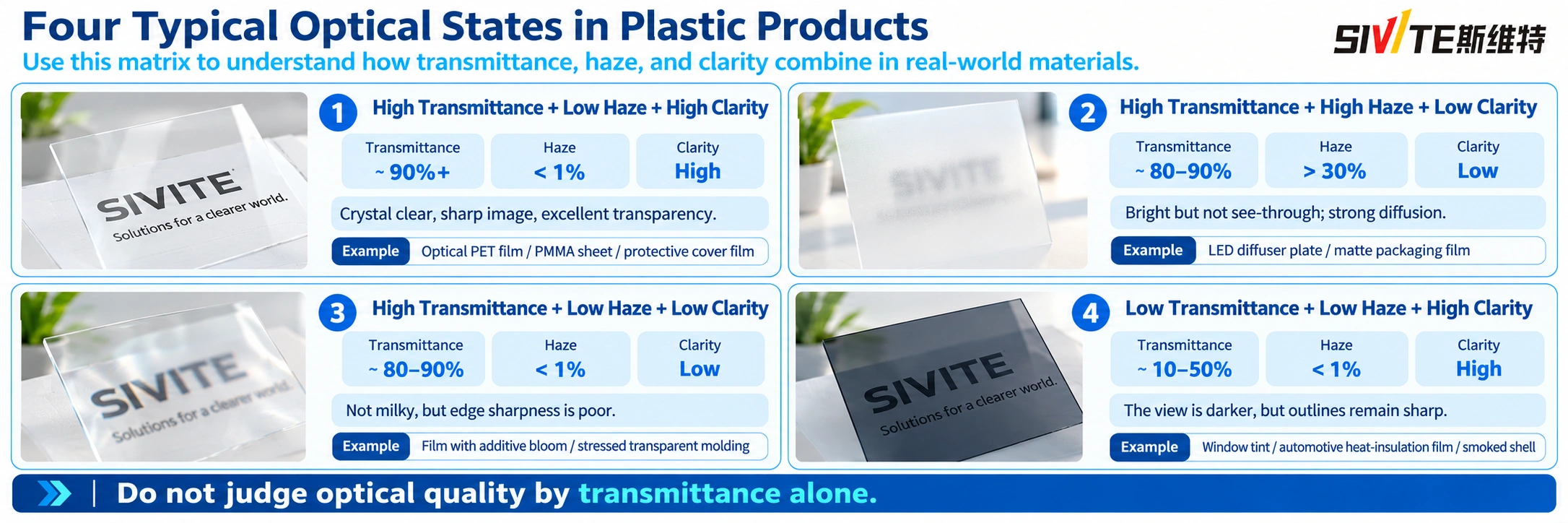
Transmittance, haze, and clarity can combine in different ways. Understanding these combinations makes it easier to identify the correct engineering solution.
Case 1: High Transmittance + Low Haze + High Clarity
Appearance: Bright, transparent, and sharply defined.
This is the desired condition for many high-visibility applications. Typical products may include optical-grade PET film, high-quality PMMA sheet, transparent protective film, and clear packaging materials.
The material allows substantial light transmission while maintaining low scattering and good image definition.
Case 2: High Transmittance + High Haze + Low Clarity
Appearance: Bright but cloudy or milky.
Typical examples include LED diffuser panels, frosted packaging films, diffusing plastic sheets, and selected matte films.
These products intentionally scatter light to reduce direct visibility or achieve more uniform illumination. High haze is not necessarily a defect. In lighting diffusion and privacy applications, it may be an important functional requirement.
Case 3: High Transmittance + Low Haze + Low Clarity
Appearance: Relatively transparent, but fine details appear blurred or distorted.
Possible examples include transparent films with small-angle scattering, films with certain surface-flow defects, materials affected by nonuniform additive blooming, and transparent molded parts with localized optical distortion.
The product may not look especially milky, but printed characters and object boundaries lose sharpness. This is why measuring haze alone may not reveal every optical-quality problem.
Case 4: Low Transmittance + Low Haze + High Clarity
Appearance: Darker, but object outlines remain sharp.
Typical examples include uniformly tinted transparent sheets, selected automotive window films, dark transparent protective covers, and certain smoked plastic products.
A uniformly absorbing colorant may reduce total light transmission without necessarily introducing strong scattering. This produces a darker image while preserving image definition.
5. How to Troubleshoot Optical Defects in Plastic Film and Sheet
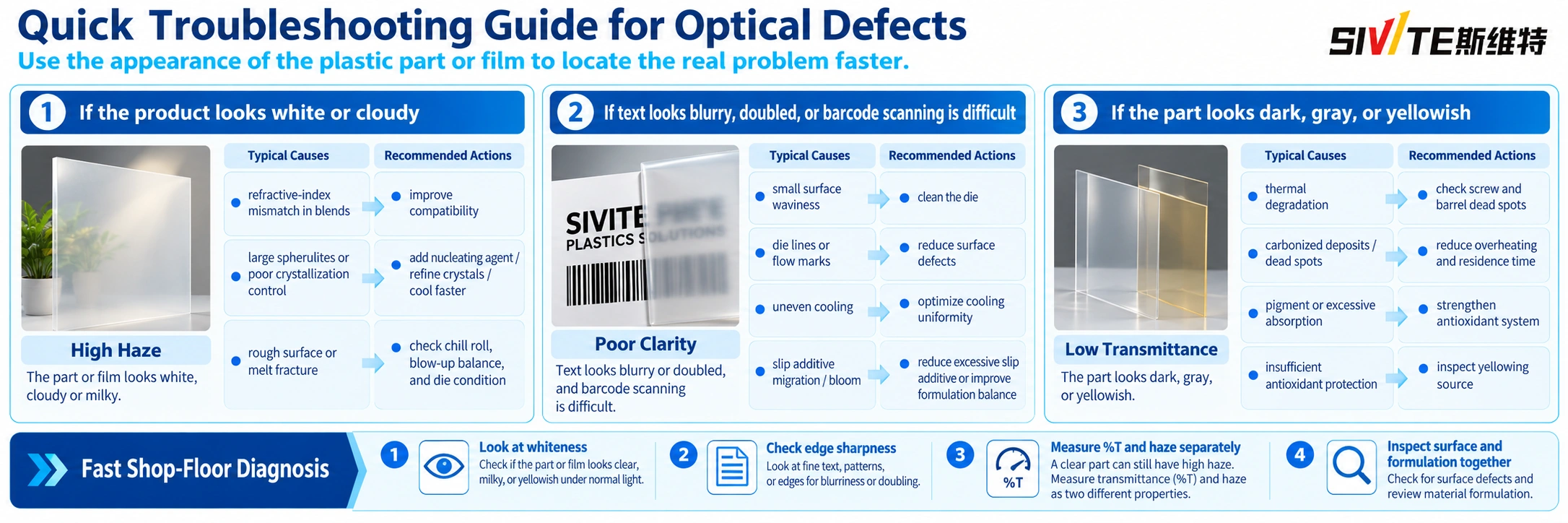
When a customer reports poor transparency, the first step is to identify the actual visual symptom.
Do not immediately change the resin, extrusion temperature, or additive formulation. Instead, determine whether the problem involves haze, clarity, or total light transmission.
Problem A: The Film Looks White, Cloudy, or Milky
Likely issue: Excessive haze
Possible causes:
- Refractive-index mismatch between polymer phases
- Poor filler dispersion
- Large crystalline structures
- Surface roughness
- Melt fracture
- Inappropriate cooling conditions
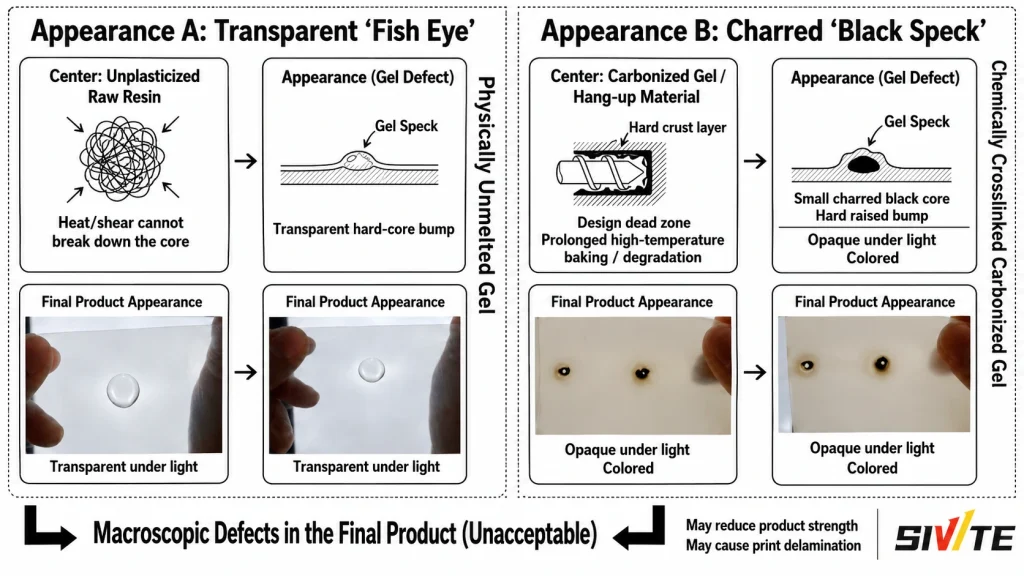
Localized specks, hard spots or lens-like inclusions should not be diagnosed as uniform haze. Compare them with the gel and fish-eye troubleshooting guide, then check contamination, incomplete melting and degradation separately.
Recommended checks:
- Measure haze using an appropriate standard method.
- Examine surface roughness and cooling-roll condition.
- Investigate blend morphology and filler dispersion.
- Review crystallization and cooling conditions.
- Test suitable clarifying or nucleating agents where appropriate.
Problem B: Text Looks Blurry or Barcodes Are Difficult to Scan
Likely issue: Poor clarity or optical distortion
Possible causes:
- Small-angle forward scattering
- Fine die lines
- Surface waviness
- Uneven cooling
- Nonuniform additive migration
- Residual stress or local optical distortion
Recommended checks:
- Examine the surface with suitable magnification.
- Inspect the die lip and melt-flow stability.
- Check chill-roll or cooling uniformity.
- Review slip-additive levels and potential surface blooming.
- Measure clarity or image sharpness using a suitable test system.
Problem C: The Film Looks Dark, Gray, or Yellowish
Likely issue: Reduced transmittance or unwanted coloration
Possible causes:
- Thermal degradation
- Oxidation
- Excessive pigment or colorant absorption
- Increased material thickness
- Contaminated raw materials
- Inadequate stabilizer performance
Recommended checks:
- Measure total luminous transmittance and color separately.
- Compare samples of equal thickness.
- Check the actual melt temperature.
- Inspect the screw, barrel, and die for stagnant material.
- Evaluate material stability, contamination, and antioxidant performance.
Do not assume every low-transmittance problem is caused by degradation. Pigments, additives, and thickness can reduce transmitted light even when the polymer is not degraded.
6. How Should Transmittance, Haze, and Clarity Be Measured?
For reliable process troubleshooting, optical results must be measured under consistent conditions.
Transmittance and Haze
ASTM D1003 covers luminous transmittance and haze of essentially transparent planar plastics using hazemeter or spectrophotometer procedures. It evaluates total hemispherical luminous transmittance and wide-angle scattering.
ISO 13468-1 covers total luminous transmittance in the visible region for planar, transparent and substantially colourless plastics. ISO 14782 covers haze resulting from wide-angle scattering in transparent materials.
ASTM D1003 explicitly notes that it is not equivalent to ISO 13468-1 and ISO 14782. Select the method required by the product specification or customer, and do not treat results from different standards or instrument geometries as interchangeable.
Clarity and Regular Transmittance
ASTM D1746 covers transparency of nominally clear and colourless plastic sheeting in terms of regular transmittance. The result correlates with see-through clarity, but it is strongly influenced by the incident-beam and receptor geometry.
For meaningful comparisons, use the same standard, instrument configuration, specimen preparation and test conditions. A visual text-distance check is useful for screening, but it does not replace an instrument-defined clarity or regular-transmittance measurement.
Important Testing Considerations
Always document:
- Specimen thickness
- Material grade
- Surface condition
- Film orientation, where relevant
- Measurement method
- Test equipment
- Sample conditioning
Comparing a 0.2 mm film with a 1.0 mm sheet without considering thickness can lead to misleading conclusions.
Likewise, two samples with similar transmittance may have very different haze and clarity.
7. Practical Recommendations for Extrusion Engineers
For transparent sheet extrusion or film production, optical quality should be monitored as part of process control.
For PET Sheet Extrusion
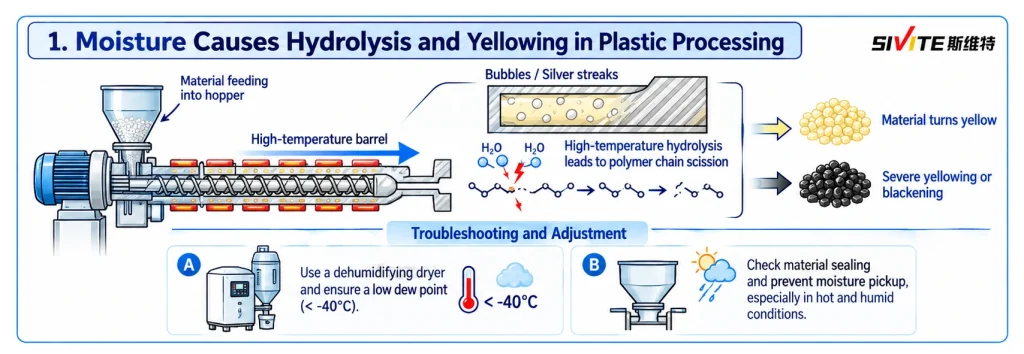
For clear amorphous PET sheet, control resin moisture, melt temperature and residence time as separate process variables. Moisture at melt-processing temperature can hydrolyze PET and reduce molecular weight, while excessive thermal history can contribute to yellowing, deposits or black specks. Crystallization and nonuniform cooling can increase scattering or haze, but drying alone should not be presented as a universal haze cure. Check moisture or material history, colour, haze and surface condition separately.
For PP Sheet and Film
PP is semi-crystalline, so optical performance depends on resin grade, crystal morphology, cooling history, thickness and any clarifier or nucleating system. Faster or more uniform cooling can change the morphology and may improve clarity for a suitable formulation, but the effect must be verified by testing. PET drying logic and process windows should not be transferred directly to PP.
For PS Sheet
Differentiate the resin family before diagnosing optics. GPPS can provide clear sheet, while rubber-modified HIPS normally prioritizes impact resistance rather than high transparency. Grade selection and additives establish the optical baseline; excessive residence time, overheating, contamination, die lines and roll-surface defects can further reduce appearance quality.
For the Sheet Line and Three-Roll Stack
Separate bulk-scattering causes from surface and thickness effects. Check melt stability, die-lip condition, thickness uniformity, unmelted particles, gels and contamination, then review roll temperature uniformity, speed matching, nip condition and roll-surface cleanliness. Uneven cooling or a damaged or contaminated roll can transfer texture to the sheet and increase scattering. Use resin-specific limits and change one variable at a time rather than applying one universal temperature or cooling rule.
Frequently Asked Questions
Can plastic film have high transmittance and high haze at the same time?
Yes. Total luminous transmittance includes directly transmitted and scattered light. A film may transmit a high percentage of incident light while scattering enough of it to appear cloudy.
What is the difference between haze and clarity?
Haze primarily describes wide-angle scattering, which creates a milky or cloudy appearance. Clarity describes how sharply objects are seen through the material and is particularly sensitive to small-angle scattering and optical distortion.
Why does text become blurry when plastic film is moved away from the printed surface?
Small-angle scattering or optical distortion causes transmitted light to deviate from its original path. As the distance between the film and the object increases, the resulting image displacement can become more noticeable.
How can haze be reduced in plastic sheet extrusion?
Potential measures include improving filler dispersion, controlling polymer morphology, optimizing cooling, eliminating melt fracture, and maintaining smooth die and roll surfaces. The correct solution depends on whether the scattering originates inside the material or at its surface.
Conclusion: Optical Quality Is More Than a Transmittance Number
In plastic film, sheet extrusion, and injection molding, high transmittance does not automatically mean excellent optical quality.
The three properties answer different questions:
- Transmittance: How much light passes through?
- Haze: How much of that light is widely scattered?
- Clarity: How sharply can objects be seen through the material?
Once these distinctions are understood, engineers can identify the real source of a transparency complaint instead of making unnecessary formulation or processing changes.
For high-quality transparent plastic products, the most effective approach is to evaluate all relevant optical properties together and connect the measurement results to material structure, surface condition, and processing history.
Need help improving transparent plastic sheet quality?
SIVITE provides plastic sheet extrusion equipment and technical support for processing applications involving PET, PP, PS, and other polymer materials.