An engineering guide to melt surface renewal, vacuum venting, melt sealing and volatile removal in plastic extrusion and compounding.
A vacuum pump is running, the gauge looks normal, yet the pellets still contain bubbles or the finished material has an unpleasant odor. In other cases, polymer starts climbing out of the vent port and operators repeatedly have to clean the opening. Installing a larger pump is tempting, but it may not solve the underlying problem.
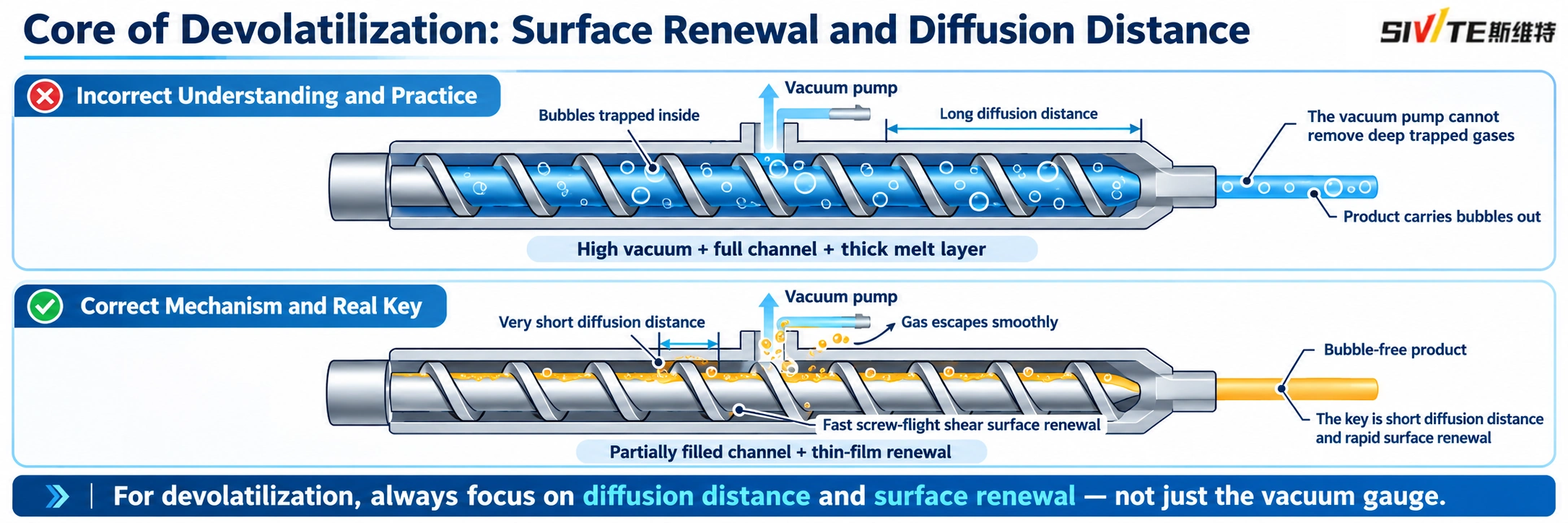
Extrusion devolatilization is a mass-transfer process, not simply a vacuum-pump problem. Moisture, residual solvents, monomers and other volatile compounds must reach a fresh melt surface, enter the gas phase and then be removed by the vacuum system. Melt surface renewal, diffusion distance, vent-zone fill level and stable pressure all matter.
This guide explains the mechanism, distinguishes poor devolatilization from vent flooding, and gives four practical routes to improvement.
1. How Does Extrusion Devolatilization Actually Work?
Short answer: Devolatilization removes volatile compounds by allowing them to diffuse through a polymer melt, transfer across the melt–gas interface and leave the barrel under controlled venting or vacuum. Creating more exposed melt surface and shortening diffusion paths can improve removal even when the vacuum reading does not change.
The process can be divided into four connected steps:
- Bulk-to-surface transport: volatile molecules move through the viscous melt toward an available surface. This can be slow when the melt layer is thick.
- Surface exposure: screw elements expose and continuously renew thin melt films, strands or surfaces.
- Desorption and evaporation: volatiles enter the gas phase, supported by temperature and a lower vapor partial pressure above the melt.
- Vapor extraction: the vent, separators, condensers and vacuum pump carry the released vapors away.
A vacuum pump helps maintain favorable gas-phase conditions and removes the released vapors. It cannot by itself make a volatile molecule travel rapidly through an excessively thick, stagnant melt layer.
Why high vacuum can still give poor results
If the screw channel is completely filled under the vent, the melt has little free surface and the gas space is restricted. Increasing vacuum in this condition can worsen foaming or entrainment without fixing the fundamental problem.
A gauge reading such as -0.09 MPa gauge pressure describes pressure relative to the surroundings; it does not measure volatile content in the finished pellet. Compare processes using absolute pressure where possible and confirm performance with product-quality measurements.
2. Why Does Melt Overflow From a Vacuum Vent?
Two mechanisms account for many vent-flow problems, although individual machines may have additional causes.
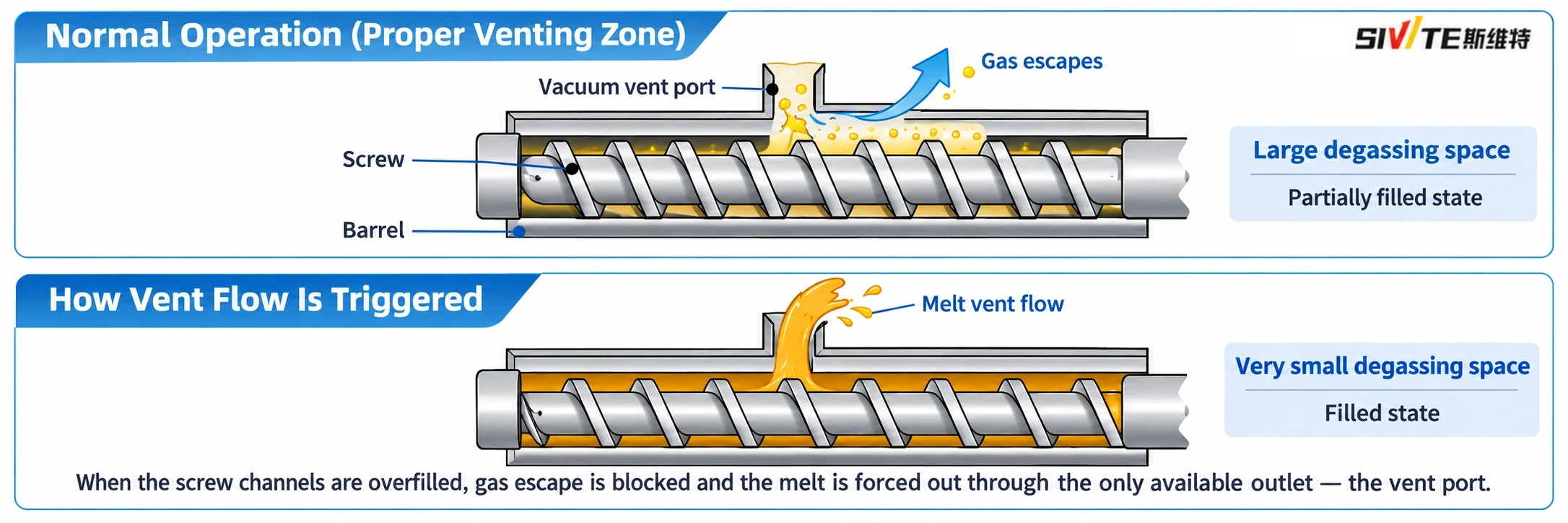
Cause A: Excessive fill level and restricted gas space
The vented screw section normally needs partially filled channels and a clear path for vapor to escape. A high local fill level can be caused by:
- Feeding more material than the vented section can convey at the selected screw speed.
- Restrictive elements downstream, excessive die pressure or a clogged screen pack.
- Incomplete melting, excessive viscosity or a cold area that causes material to accumulate.
- Screw geometry that does not create sufficient conveying capacity around the vent.
When the free volume disappears, melt pressure can rise toward the opening and force polymer out through the vent.
Cause B: Flashing, foam expansion and droplet entrainment
A melt rich in moisture or solvent may foam when it enters a low-pressure zone. Rapid bubble growth and rupture can throw droplets upward; high gas velocity can carry them into the vent housing. Deposits on cooler surfaces may eventually obstruct the opening.
Important distinction: Vent flooding concerns melt arriving at or escaping through the vent. Poor devolatilization concerns volatile material remaining in the product. The problems can occur together, but they require different diagnostic decisions.
For a detailed vent-overflow checklist, see Extruder Vent Overflow: Four Root Causes and a Practical Troubleshooting Guide.
3. Four Practical Ways to Improve Extrusion Devolatilization
Method 1: Increase melt surface renewal and reduce diffusion distance
A thick, stagnant melt layer gives volatile molecules a long path to the surface. A venting section should expose fresh melt repeatedly while retaining enough open channel volume for vapor removal.
Depending on the extruder design, engineers can evaluate deep-channel or large-pitch conveying elements, suitable multi-start elements and specialized surface-renewal geometry. The aim is thin melt layers and repeated surface turnover, not maximum shear intensity.
Check that the screw still transports material away from the vent. Mixing elements that generate high shear without adequate conveying capacity can cause local overheating or flooding.
Method 2: Establish a stable upstream melt seal
A melt seal helps isolate the vacuum zone from atmospheric air entering through the upstream feed system. In many twin-screw arrangements, an appropriately filled upstream section or selected restrictive/mixing elements provide this seal.
The seal needs to be effective but not excessively restrictive. Too much restriction can increase specific mechanical energy, melt temperature and pressure, creating another problem upstream of the vent.
Confirm complete melting before the vacuum zone, verify sealing performance, and check whether downstream elements can carry the required throughput without pushing melt back toward the port. Do not prescribe a fixed number or angle of kneading blocks for every machine.
Method 3: Consider stripping for demanding low-odor and low-VOC formulations
In suitable processes, a carefully metered stripping medium can assist removal of high-boiling residual volatiles by increasing vapor-phase transport and promoting bubble formation. Industrial designs may use an inert gas, CO₂ or, for appropriate polymers, a water-based stripping stage.
Water stripping is not a universal fix. PET, PBT, PLA, PC, PA and other hydrolysis-sensitive materials may degrade when water is introduced into hot melt. Specialized systems require validated resin compatibility, injection and pressure controls, downstream vapor removal and safety provisions. Do not copy a generic stripping dosage from another formulation.
For demanding applications, define a measurable residual-VOC or odor target before changing the process.
Method 4: Control vent-port and housing temperature
A cold vent housing can cause splashed polymer to solidify and build up. Deposits narrow the gas passage and can increase local gas velocity and entrainment.
Verify heater operation, sensor location, insulation and housing temperature. The objective is to avoid cold surfaces where melt accumulates without overheating the polymer or condensing volatile species in an uncontrolled location. Separators and condensers should be designed to capture vapor away from the hot port.
4. Troubleshooting Table: Match Symptoms to Likely Causes
| Production symptom | First items to check | Practical next step |
|---|---|---|
| High vacuum but bubbles remain in pellets | Moisture input, thick melt layers, insufficient surface renewal, residence time | Measure residual moisture or volatiles; review vent-zone fill level and screw configuration |
| Melt rises into the vent | Feed/screw-speed balance, downstream restriction, die/screen backpressure | Lower local fill level and verify conveying capacity |
| Sudden foaming under vacuum | Volatile load, pressure-drop rate, melt strength | Increase vacuum gradually and control feed and temperature |
| Vent port repeatedly clogs | Cold vent housing, droplet entrainment, inadequate separator | Restore temperature control and inspect vapor-path geometry |
| Odor persists despite stable production | High-boiling volatile species, mass-transfer limitations, inadequate downstream removal | Set a residual-VOC target; assess multi-stage venting or validated stripping |
Change one variable at a time and record resin grade, feed rate, screw speed, barrel and measured melt temperatures, head pressure, vent-zone absolute pressure and product defects. Repeatable measurements are more useful than a vacuum reading alone.
5. How to Verify That Devolatilization Has Improved
Do not define success only by a stronger gauge reading. Use outcomes relevant to your resin and product:
- Residual moisture, using a suitable validated method for the resin.
- Residual volatiles or monomers, using an appropriate laboratory method such as headspace GC where required.
- Bubble and void incidence in pellets, extruded sheet or molded test pieces.
- Odor and color stability, measured consistently against a baseline when these are the target defects.
- Output, motor load and melt temperature, to confirm the improvement is stable and does not create excessive degradation or cost.
When running trials, compare under the same resin batch and throughput conditions as far as practical. A favorable laboratory result does not automatically establish identical performance at production scale.
6. Frequently Asked Questions
Does a higher vacuum always improve extrusion devolatilization?
No. Lower pressure can aid evaporation, but poor melt surface renewal, high fill level and excessive foam entrainment can limit or even destabilize the process. Evaluate absolute pressure together with melt exposure and product test results.
Why are my pellets still bubbly when the vacuum gauge looks normal?
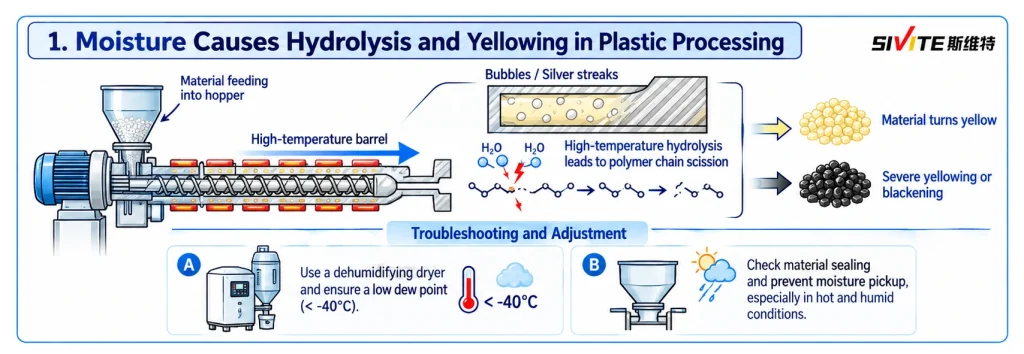
Volatiles may remain trapped because the melt layer is too thick, the vent zone is overfilled, the material was insufficiently dried, or the residence time and exposed surface are inadequate. Check the product and the screw process before replacing the pump.
What causes polymer to come out of the vent port?
A local channel fill level that is too high, downstream restriction and rapid flashing of volatiles are common mechanisms. See the dedicated extruder vent overflow troubleshooting guide for detailed fault isolation.
Can water injection reduce odor in every polymer?
No. Stripping-media selection is resin-specific. Introducing water into hydrolysis-sensitive polymers can lower molecular weight or worsen defects; any stripping approach must be engineered and validated.
Conclusion: Optimize Mass Transfer, Not Just the Gauge
Reliable extrusion devolatilization comes from the combined control of melt surface renewal, diffusion distance, fill level, melt sealing, temperature and vapor extraction.
A more powerful vacuum pump is useful only when the rest of the system can expose and release the volatile compounds. Start with material condition and vent-zone behavior, then refine screw geometry and vacuum hardware based on measured results.
Need help assessing bubbles, vent flooding or unstable sheet quality? Share your resin, throughput, extruder configuration, vent pressure and production symptoms with SWT Extrusion so the engineering team can review possible equipment and process adjustments.
Engineering note: Examples and diagrams are intended to explain mechanisms, not prescribe universal operating setpoints. Follow the equipment manufacturer’s limits and material supplier’s processing recommendations.