Stop trial-and-error adjustment with temperature-speed-output 3D optimization.
In twin screw compounding, many engineers have experienced the same frustrating situation:
The formulation remains unchanged, but mechanical properties suddenly fluctuate.
A rainy day with lower ambient temperature, or increasing screw speed and output to meet production demand, can cause tensile strength, impact strength and dispersion quality to change significantly.
In many compounding factories, process optimization still relies heavily on operator experience:
- Reduce temperature by 5°C when material becomes degraded.
- Reduce screw speed when glass fibers become shorter.
- Increase output when production demand rises.
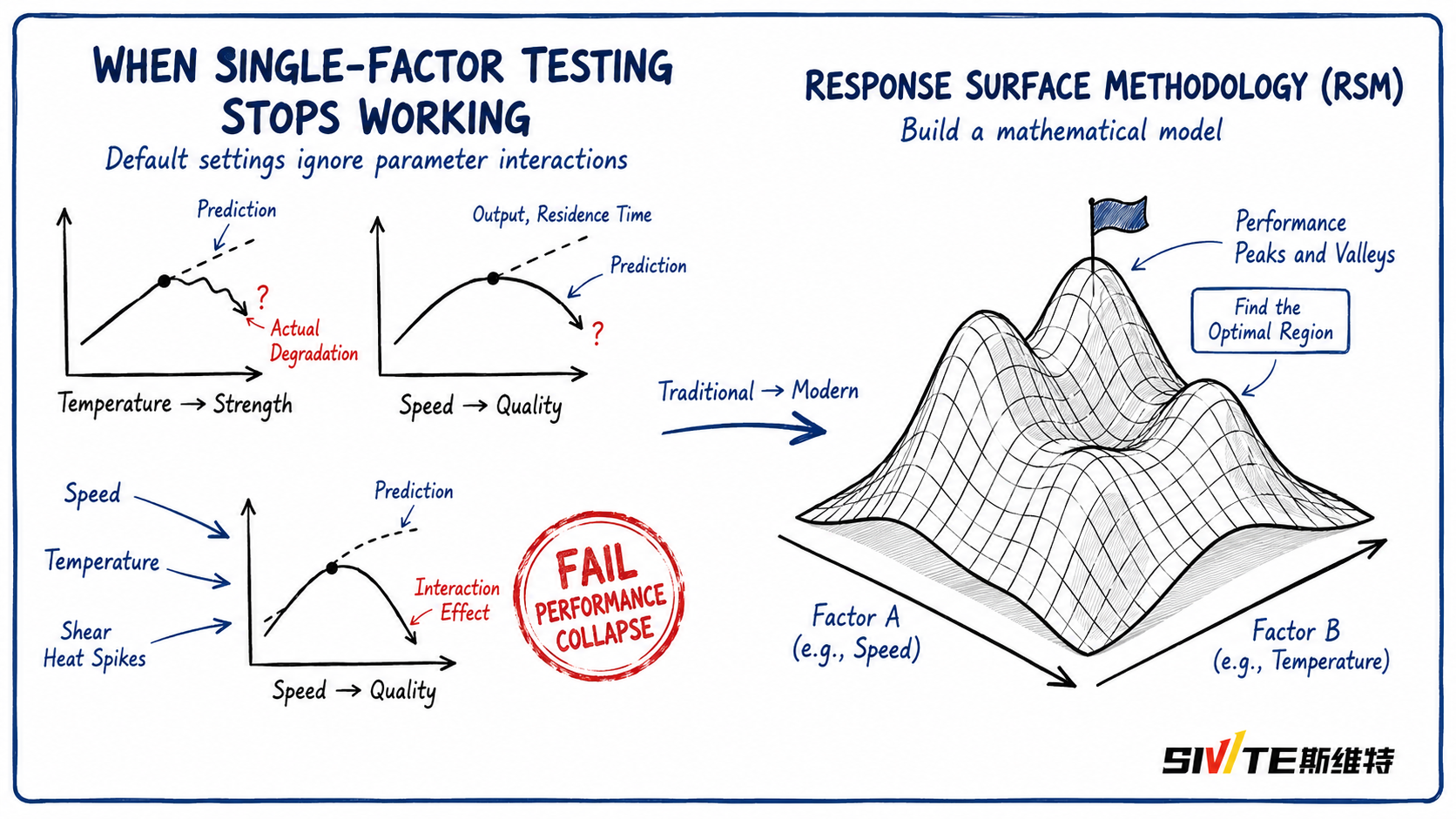
However, traditional single-factor adjustment often creates new problems while solving the original one.
Because inside a twin screw extruder:
Temperature, screw speed and output are never independent.
They interact with each other and determine:
- Shear history
- Residence time
- Melt temperature
- Filler dispersion
- Polymer degradation
- Final mechanical properties
This is why Response Surface Methodology (RSM) has become an advanced tool for extrusion process optimization.
1. Why Traditional Single-Factor Optimization Is No Longer Enough?
Traditional extrusion development often uses:
- Single-variable experiments
- Orthogonal experiments
- Trial-and-error adjustment
The problem is:
These methods assume process parameters do not interact.
But in reality, strong interactions always exist.
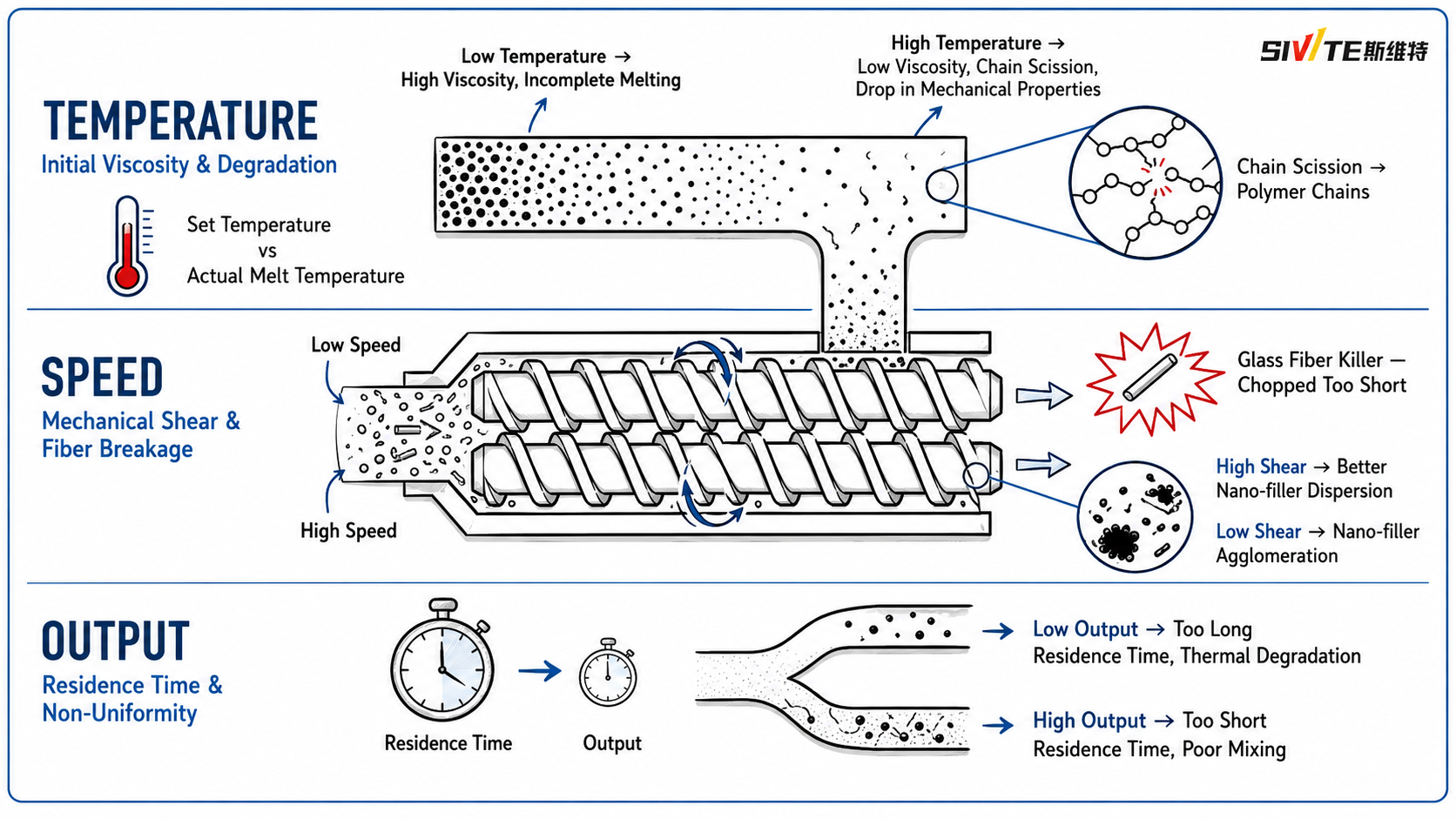
Temperature and Screw Speed Interaction
Lower barrel temperature does not always mean lower melt temperature.
When screw speed increases:
- Mechanical shear increases
- Viscous heating increases
- Actual melt temperature may exceed the setting
Possible results:
- Polymer degradation
- Molecular chain damage
- Lower mechanical properties
Output and Screw Speed Interaction
Output controls residence time.
Higher output:
- Shorter residence time
- Less thermal exposure
Lower output:
- Longer residence time
- Higher degradation risk
Higher screw speed increases shear.
Incorrect matching may cause:
- Poor dispersion
- Fiber breakage
- Unstable properties
Therefore, optimization requires a multi-variable method.
2. Three Core Parameters in Twin Screw Extrusion Optimization
Temperature
Viscosity
Molecular degradation
Screw Speed
Shear
Fiber damage
Output
Residence time
Dispersion
Temperature — Controls Melt Viscosity and Degradation
Temperature determines polymer melt viscosity.
Too low:
- Incomplete melting
- Poor dispersion
- High torque
Too high:
- Polymer degradation
- Reduced mechanical strength
The goal is not the highest temperature.
The goal is the optimal melt condition.
Screw Speed — Controls Shear and Dispersion
Higher screw speed improves:
- Filler dispersion
- Polymer blending
- Mixing efficiency
However, excessive shear damages sensitive materials.
For glass fiber reinforced compounds:
Too much shear shortens fibers and reduces reinforcement.
Output Rate — Controls Residence Time
Output determines how long material stays inside the extruder.
Too low:
- Overheating
- Thermal degradation
Too high:
- Insufficient mixing
- Poor dispersion
The best condition is the balance between:
Throughput + Mixing + Thermal History
3. Practical Application of Response Surface Methodology (RSM)
A common optimization method is:
Box-Behnken Design (BBD)
Instead of hundreds of random experiments, RSM creates a mathematical model using limited but meaningful experiments.
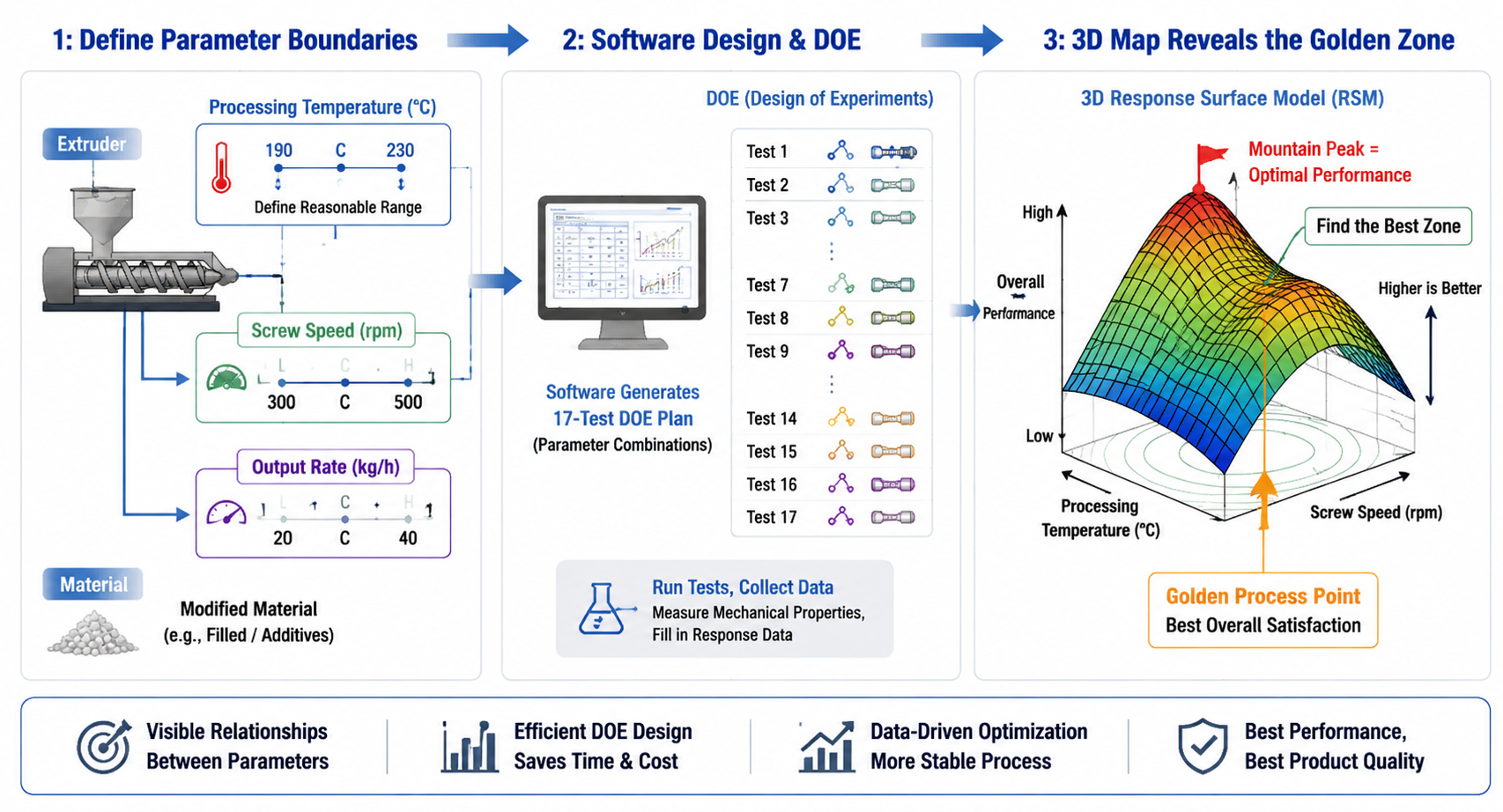
Step 1: Define Parameter Boundaries
Example:
Processing Temperature:
190°C – 230°C
Screw Speed:
300 rpm – 500 rpm
Output:
20 kg/h – 40 kg/h
Step 2: Experimental Design and Testing
Software such as Design-Expert generates experiment combinations.
The process includes:
- Twin screw extrusion testing
- Sample preparation
- Mechanical testing
- Data analysis
The software builds relationships between:
Input:
- Temperature
- Screw speed
- Output
and responses:
- Impact strength
- Tensile strength
- Dispersion quality
4. Understanding the Golden Processing Window
The software generates:
- 3D response surface plots
- Contour maps
These reveal hidden relationships.
Steep Mountain vs Flat Plateau
A steep surface means:
The material is highly sensitive to parameter changes.
A flat high-performance area means:
A wider processing window and easier production control.
Elliptical Contour Lines
Elliptical contour lines indicate strong interaction between parameters.
For example:
Low temperature requires lower screw speed.
Higher temperature allows higher screw speed.
This relationship is difficult to discover through experience alone.
5. Multi-Objective Optimization
Real production rarely optimizes only one property.
Engineers usually require:
- High impact strength
- High tensile strength
- Stable production
- Higher output
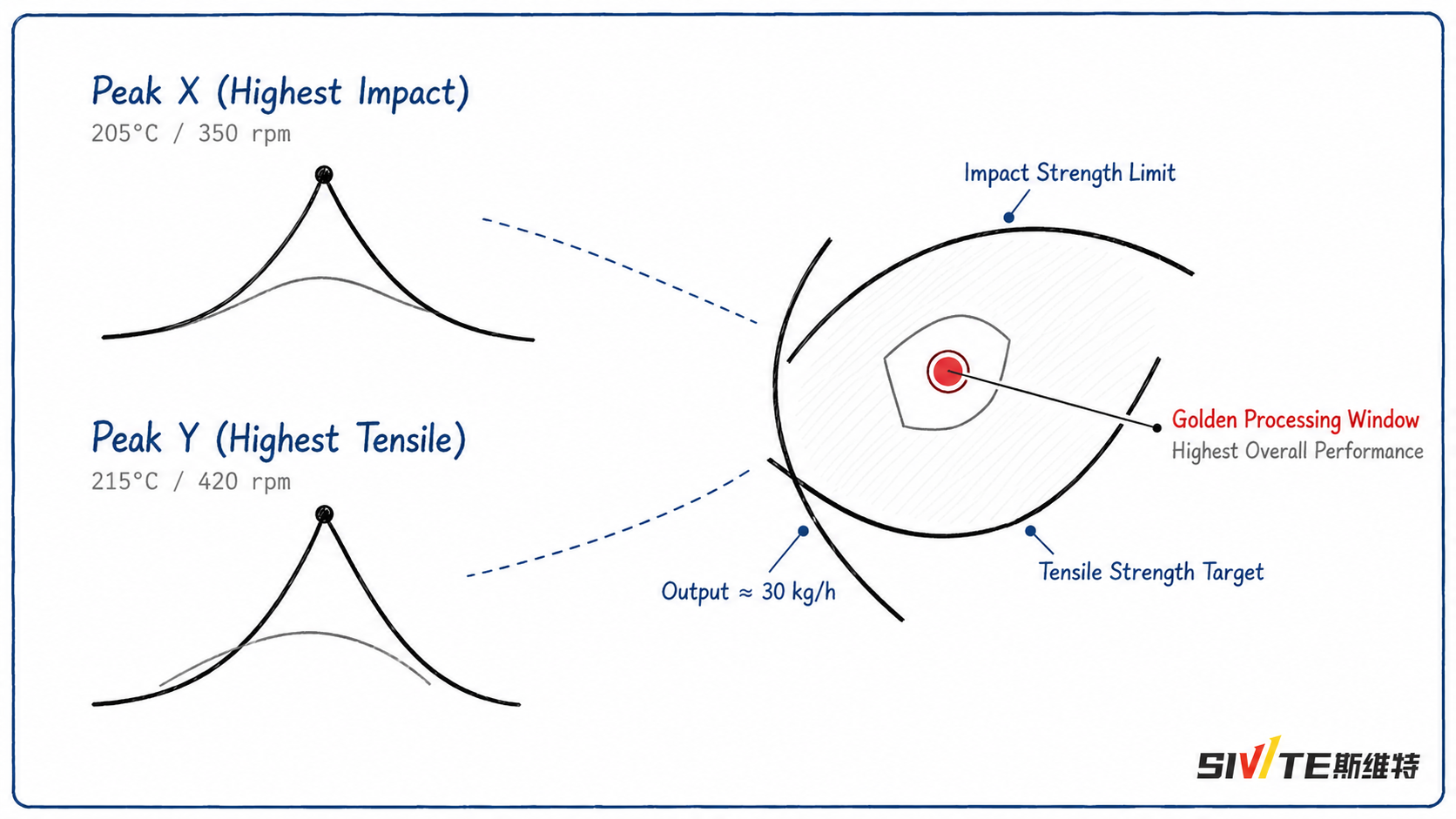
Peak A
Temperature: 205°C
Screw speed: 350 rpm
Output: 25 kg/h
→ Maximum impact strength
Peak B
Temperature: 215°C
Screw speed: 420 rpm
Output: 32 kg/h
→ Maximum tensile strength
RSM can combine multiple targets.
The software calculates the best balance point:
The Golden Processing Window.
Conclusion
Plastic compounding has entered an era where formulation alone is no longer enough.
The future competition is:
- Precise process control
- Scientific optimization
- Data-driven extrusion management
Response Surface Methodology transforms extrusion adjustment from:
“Operator experience”
into:
“Predictable engineering control.”
Finding the correct relationship between temperature, screw speed and output is the key to stable production and consistent product performance.
Related Equipment
Sheet Extrusion Lines
For PET, PP and PS sheet production, review the extrusion configurations and engineering options relevant to this technical topic.
View Sheet Extrusion LinesDiscuss your application on WhatsApp